
The agreement was formalized during an official visit by Olli-Pekka Heinonen, Director General of the International Baccalaureate (IB), to the headquarters of the Islamic World Educational, Scientific and Cultural Organization in Rabat. He was received by Salim M. AlMalik, Director General of ICESCO. Following the signing ceremony, both leaders engaged in a bilateral discussion focused on exploring future initiatives and collaborative opportunities, reinforcing IB–ICESCO partnership, global education collaboration, and international education development.
Under the Memorandum of Understanding (MoU), the two organizations will work together to strengthen education systems in ICESCO member states. The partnership will focus on enhancing government capacity in education, aligning with IB educational frameworks, fostering innovation in teaching and learning, and promoting education sector dialogue. These efforts are aligned with the broader objectives of the United Nations and its Sustainable Development Goals (SDGs), particularly in advancing quality education, inclusive education systems, and sustainable global development.
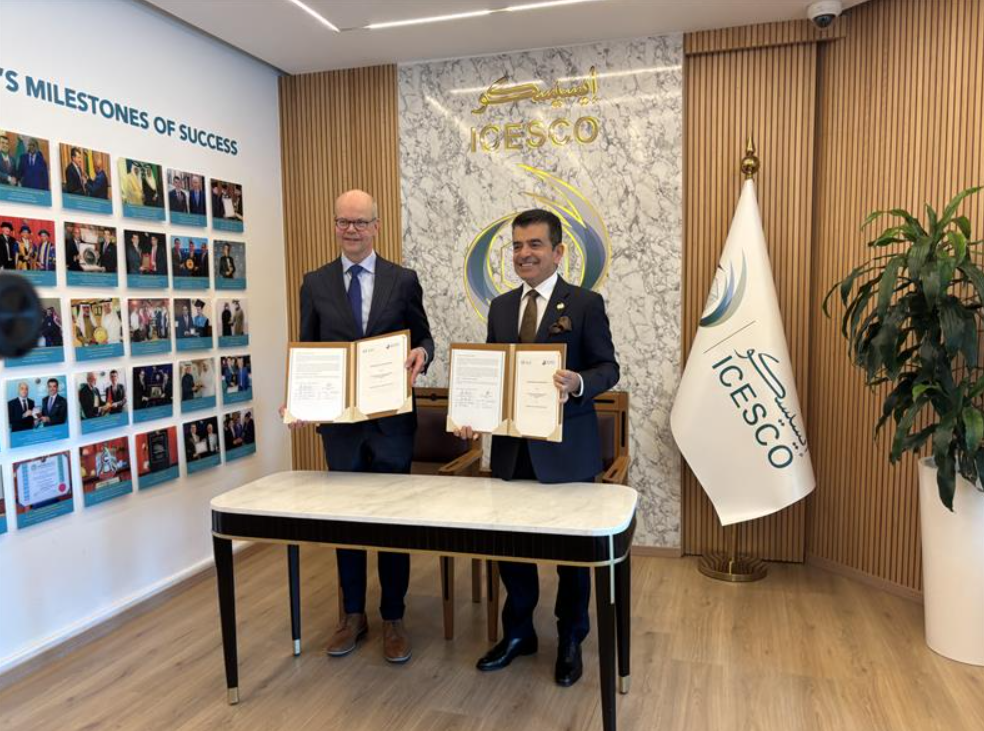
The agreement builds upon an earlier collaboration that began during ICESCO’s third conference of education ministers held in Muscat in October 2024. During this event, the International Baccalaureate (IB) was invited to co-develop a joint policy paper focused on improving teaching quality and education policy development. Designed to be adaptable across diverse national contexts, the policy emphasizes IB’s evidence-based education approach and professional development for teachers as a model that can be effectively integrated into national education systems.
The collaboration is expected to focus on improving access to quality education, promoting innovative teaching practices, and equipping students with 21st-century skills for the modern world. By combining IB’s international curriculum frameworks with the regional expertise of the Islamic World Educational, Scientific and Cultural Organization, the partnership aims to create more inclusive education systems and effective learning environments.
Officials from both organizations highlighted the importance of cooperation in addressing current education challenges, including digital transformation in education, teacher training programs, and curriculum modernization. The initiative will also emphasize cultural exchange in education and the integration of global perspectives in learning into local education systems.
Through joint education programs, teacher workshops, and resource-sharing initiatives, IB and ICESCO plan to empower educators and policymakers while enhancing student learning outcomes across participating nations. This strengthened alliance marks a significant step toward sustainable educational development and preparing learners to thrive in an interconnected global society.
Why is improving teaching quality considered the foundation of a strong education system?
Improving teaching quality is widely regarded as one of the most impactful ways to enhance an education system because teachers directly influence student learning outcomes. A well-trained and supported teacher can adapt to different learning styles, foster critical thinking, and create an engaging classroom environment. When educators are equipped with modern teaching methodologies and continuous professional development, supported by AI in education and EdTech innovation, they can better prepare students for real-world challenges.
Moreover, strong teaching practices help bridge gaps in educational inequality. In many regions, disparities in resources and infrastructure exist, but high-quality teaching—enhanced through personalized learning and digital learning platforms—can significantly mitigate these challenges. Effective teachers not only deliver knowledge but also inspire curiosity, creativity, and lifelong learning. This is why organizations like IB and ICESCO emphasize professional learning and capacity building as key pillars of educational reform, increasingly integrating AI-powered learning solutions.
Reflecting this vision, Heinonen stated that the partnership is designed as a long-term commitment aimed at benefiting students, teachers, and governments alike. He emphasized the shared goal of both organizations to empower younger generations through meaningful, future-ready education, driven by EdTech AI and scalable learning models. He also highlighted that equipping teachers with the right tools and approaches, including AI automation platforms, remains central to improving overall educational quality.
Currently, IB offers 981 educational programmes across 529 schools in 38 ICESCO member states. Since 2025, it has further expanded its reach across the Islamic world by establishing partnerships in countries such as Bahrain, Egypt, and Indonesia. These efforts align with IB’s broader mission to foster a more peaceful and interconnected world through comprehensive, high-quality, and technology-enabled education systems.
Conclusion
The strengthened partnership between IB and ICESCO represents a forward-looking step in global education reform. By focusing on teacher development, policy collaboration, and shared educational goals, the alliance has the potential to create lasting impact across member states. As education continues to evolve in response to global challenges, such collaborations play a crucial role in ensuring that learning systems remain inclusive, adaptive, and future-oriented.