
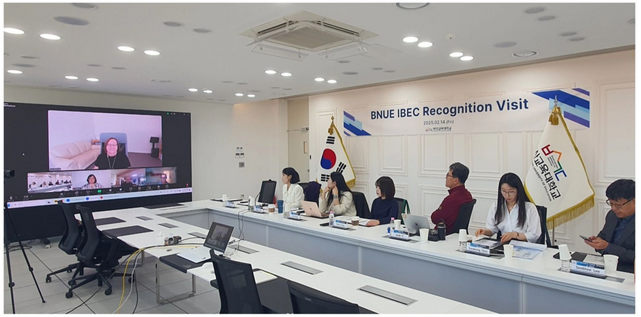
The process of expanding the International Baccalaureate Educator Certificates (IBEC) in South Korea had an unexpected start, which later transformed into an example of a successful systemic change in the education system. The process that started out as an impromptu project at the beginning of the pandemic eventually became an ongoing mission aimed at promoting the growth of teaching and leadership that would be aligned with IB ideology.
The collaboration was initiated in response to launching North London Collegiate School in Jeju and managing a school in New York. A university dean from South Korea expressed an interest in the possibility of creating teaching programmes that could be compatible with IB teaching methodology, thus making IBEC possible for these institutions. IBEC is a series of certificates provided by recognised university degrees issued by more than 50 universities in 16 different countries, designed to help students obtain essential skills and mindsets to become effective IB educators.
Rapid Growth of IBEC and IB World Schools
Since 2020, six South Korean universities have succeeded in receiving IBEC accreditation, which has been an important milestone towards creating a stable pipeline of qualified IB educators. A considerable amount of progress has been achieved. Scores of teachers have participated in IBEC programmes, and numerous graduates have already started working as coordinators and heads of IB World Schools. It can be said that a solid base has been laid to introduce IB philosophy in the classroom practice, contributing to the rapid dissemination of IB education across the country.
The other noteworthy point about South Korea’s experience is related to the explosive development of IB World Schools in the region. About six years ago, there were no public IB World Schools in the country; however, since the IB established cooperation with two regional offices of education, 70 schools are currently functioning under the IB programme. The forecasts show that in the nearest future, their number may grow up to 100 schools, possibly reaching 200 within several years. The rapid expansion of this educational trend in South Korea has never happened before.
This is made possible due to the cooperation between universities and education departments within these regions. For instance, in South Korea, local education departments fund the tuition fees paid by teachers pursuing IBEC courses. Consequently, there is always a constant influx of experienced individuals well-trained in IB curricula and willing to undertake leadership positions in schools implementing the program. Thus, institutions not only have the program in place but also qualified personnel to help maintain and expand the same.
Secondly, the Korean model is strong because there is a close partnership between the universities and IB World Schools. Teacher trainees in IBEC programs must undertake their practical training in neighboring IB World Schools. Such exposure is important since trainees will get to see how IB curriculum can be put into practice. As a consequence, graduates become experienced and capable of applying what they learnt from universities into practice.
Transforming Teaching and Prioritising Wellbeing
While many positive aspects can be attributed to the IB program in Korea, some challenges still exist. One such challenge is related to developing cooperation between the public and international sectors in IB World Schools. Traditionally, these sectors have worked relatively separately from each other. Yet, currently attempts are being made to overcome this divide by organizing events like the Korean Association of IB World Schools that focuses on creating an environment of collaboration, knowledge exchange, and professional development for all involved stakeholders.
Moreover, the IBEC project plays a very important role in revolutionizing the methods of teaching within the education system of Korea. Traditionally, Korean education placed more importance on rote memorization rather than active participation of students in learning. Some schools have attempted to shift away from the former toward the latter but IB programs in Korea managed to facilitate this process.
The influence of IBEC goes beyond the scope of individual teachers. Up until now, there have been more than 800 teachers who have enrolled in IBEC courses in South Korea. They have often played an important role by spreading the word and encouraging other colleagues to follow the IB philosophy. As a result, this approach not only increased the effectiveness of IBEC but also led to an even greater transformation of the culture in the education sector. It became more important for the Ministry of Education to encourage IB courses in public institutions.
One of the most notable features of the IBEC programme in South Korea is a special focus on student well-being. Indeed, there are many problems concerning the mental state of the students. There is too much stress connected with studying, and the youth suicide rate in the country is one of the highest worldwide. Thus, IBEC training focuses on providing an atmosphere in which students would be happy and comfortable enough to share their experiences.
Regarding its future in South Korea, IBEC looks bright and hopeful. At the moment, there are 12 education offices out of 17 that are taking part in the journey of the International Baccalaureate. In addition, it is worth noting that additional 5 offices are likely to become interested in the project in the nearest future. The aim of the project in this case is the development of a balanced and inclusive educational system that will respond to the changing demands of the modern society.
As for other countries and universities that want to implement similar programs, they should follow a number of guidelines. To begin with, close cooperation between universities, education offices and IB schools is of primary importance. Teacher trainings and experience are to become a priority, along with an understanding of local educational problems and needs.
The experience of South Korea with IBEC clearly shows how through cooperation, innovations, and dedication to improvement, one can change the education system completely. By focusing on both quality learning and student welfare, this nation gives an excellent example of how education can be reformed for future success.