

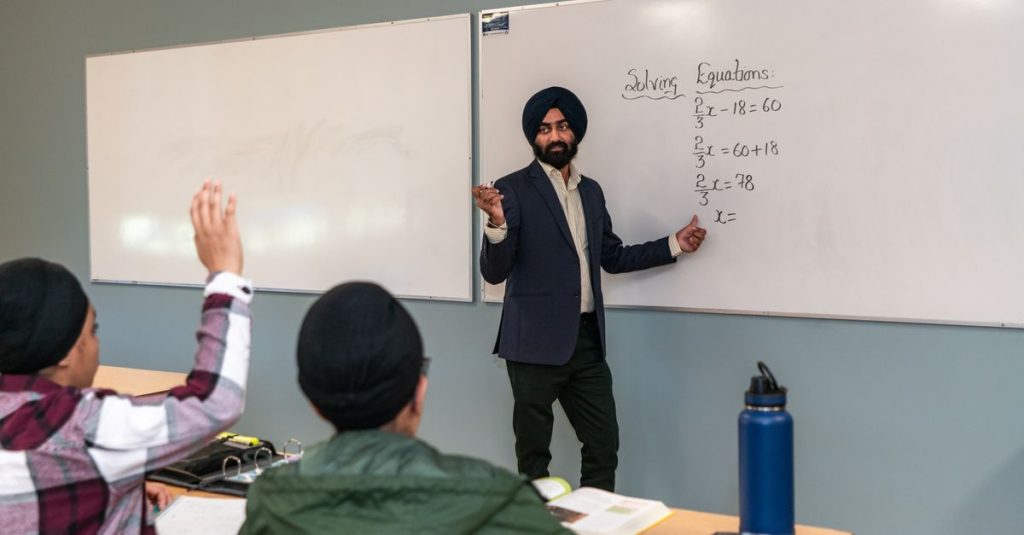
The International Baccalaureate (IB) still emphasizes many motivating stories from educators that align with its philosophy of focusing on learners. An example is one that can be found from Matthew Rinehart, an IB math teacher in Northern Middle School in Maryland in the United States. His decision to become an educator was different from what many people do. The inspiration behind it came from his personal change rather than ambition.
As a banker, Rinehart dealt with numbers, logic, and problem-solving skills. But being a father made him shift priorities in life, making him leave his job in banking and take up teaching. In the process, he discovered that mathematics was his niche after starting with elementary teaching. The realization gave him an agenda which is to enable students to believe that they can achieve anything in math.
Building Confidence Through a Growth Mindset
One of the most important pillars of Rinehart’s teaching methodology is instilling in students, especially those struggling in math, a growth mindset. Many students come into his class with the baggage of having previously struggled with the subject matter and being frustrated with their lack of success.
Rather than emphasizing results, he stresses perseverance, reflection, and hard work as crucial components of success. He helps students see failures as chances for learning and progress, and he creates an environment in which learning can happen without fear of mistakes.
This aligns with IB values very well, because at the heart of the IB system lies the idea that students are agents of their own education, and they should be encouraged to reflect and learn constantly throughout their life journey.
Personalised Learning and Strong Relationships
Understanding that all students learn in different ways, Rinehart makes use of small groups for instructional purposes. In doing so, Rinehart will be able to closely follow up on his students’ progress and give feedback while being able to create lessons that would fit their needs. In addition to using formulas, Rinehart uses other means to ensure that all students understand mathematical concepts, like using manipulatives, number lines, and graph papers.
Such an individualised teaching strategy is especially beneficial for IEPs as Rinehart collaborates with students from various grade levels and builds relationships that allow him to get familiar with the learning peculiarities of individual students and work towards setting appropriate goals.
In addition to individualisation, another essential aspect of the teaching practice of Rinehart is collaboration. Rinehart not only collaborates with other teachers, like his colleagues at the school but also with case managers and other specialists to ensure consistent and effective educational experiences.
On top of that, Rinehart places great importance on building relationships with his students and believes that confidence arises out of trust, empathy, and mutual respect.
There is an interesting illustration of this point. One student who had been unwilling to get involved in tests turned out to be much more interested once he was able to establish goals for himself. It shows the effectiveness of getting students actively involved in the process.
The Lasting Impact of Compassionate Teaching
The effects of Rinehart’s work do not stop within the walls of the classroom. His former students reach out after many years, updating him about their accomplishments. This reaffirms how crucial it is to provide instruction that promotes not just learning but also development.
Parents have also acknowledged Rinehart’s passion for teaching. In an evaluation for the Presidential Awards for Excellence in Mathematics and Science Teaching (PAEMST), one parent commended his efforts to foster success while nurturing self-esteem.
In spite of the difficulties associated with instructing students who struggle, Rinehart feels driven to fulfill his role. He manages to juggle his responsibilities by interacting with a diverse group of learners and joining extracurricular activities, thus sustaining his zeal for teaching.
Rinehart’s philosophy rests on several essential beliefs: encouraging students to adopt a growth mindset, cultivating meaningful connections, collaborating with peers, reflection, and humility. These principles mirror the IB philosophy, which strives to create empathetic, competent, and introspective learners.
In conclusion, the above story by Rinehart proves that math teaching goes beyond the subject itself since it involves the element of empowerment. Through encouraging his students to have confidence in themselves, Rinehart is able to change how they approach their education.